Week in Product #468 🚀
Salesforce's Agentforce momentum, ChatGPT personalization, NotebookLM-Gemini integration, 2025 LLM trends, Top skills for AI PMs, Ideas for 2026 & more

Hi friends 👋
Happy weekend, happy holidays, and welcome to a new Week in Product!
🎰 The week in figures
$20B: Nvidia struck a $20B licensing deal with AI chip startup Groq, hiring its founder and team. This is Nvidia's largest-ever deal and a strategic move to maintain AI dominance
$1B: Resolve AI, a startup developing an autonomous "AI Site Reliability Engineer" to automate software maintenance and troubleshooting, has secured an undisclosed Series A funding at a $1B valuation
$540M: Salesforce quietly added 6K enterprise AI customers in a quarter (48% growth), pushing Agentforce past 18.5K customers and $540M+ in agentic ARR
$350M: neo-bank Erebor raised $350M at a $4.35B valuation
$150M: Imprint raised $150M in Series D, reaching unicorn status as it expands its co-branded credit card and embedded finance platform
19%: Global internet traffic grew 19% in 2025 with Google remaining the most visited website worldwide Android dominates web traffic with a 65% share, and despite new AI entrants, Chrome still leads at just under 66% of the browser market
📰 What’s going on
Amazon is adding 4 service integrations to its AI-powered Alexa+, allowing users to book hotels, get home service quotes, and schedule appointments with Angi, Expedia, Square, and Yelp starting in 2026. These integrations join existing partnerships with Fodor, OpenTable, Suno, Ticketmaster, Thumbtack, and Uber, creating a ChatGPT-style app ecosystem where users access multiple services through conversational AI
OpenAI added personalization controls so you can dial ChatGPT’s warmth/enthusiasm (and emoji energy) up or down
OpenAI shared that AI browsers face persistent prompt injection vulnerabilities unlikely to be fully solved
Google pushed back its plan to replace Assistant with Gemini on Android devices, extending the timeline into 2026. The company cited the need for “a seamless transition” after originally targeting completion by end of 2025. Gemini has already launched on Wear OS watches, Android Auto, and Nest devices. Mobile integration presents more complex engineering challenges
NotebookLM recently integrated with Gemini, allowing you to upload notebooks for combining multiple ones, and:
Rolled out chat history syncing across mobile and web so you can pick up conversations seamlessly and delete them anytime for privacy
Added export options for your study guides, briefing docs, or saved notes directly to Google Docs or Sheets for easy editing on the go
Introduced data tables to all Pro and Ultra users (coming soon to free) for organizing scattered insights and exporting them to Sheets
Teased an easter egg in their latest featured notebook hinting at new British voices coming in 2026
And shared 8 ways to maximize slide decks like turning holiday research into branded presentations

Instacart has halted its AI-driven pricing tests after a joint report from Consumer Reports and Groundwork Collaborative revealed that shoppers were being charged different prices for identical items. The study tracked over 400 customers and found price gaps as high as 23% for the same products purchased from the same store on the same day
📚 Good reads
2025 LLM year in review. Andrej Karpathy identifies six 2025 paradigm shifts: RLVR emerging as the new training stage, LLMs displaying “jagged intelligence,“ Cursor revealing a new LLM app layer, Claude Code demonstrating the value of local AI agents, “vibe coding“ making programming accessible to anyone, and Nano banana hinting at the “LLM GUI“ where models speak through images and web apps rather than text
Why Instagram’s new navigation changes are a classic example of data-driven UX. Instagram’s head Adam Mosseri said almost all their recent growth comes from Reels, DMs (now Chat), and recommendations. This thread breaks down some of the reasons why a change was recently made
A collection of free mini vibe-coding courses. Replit launched a collection of new, free courses it’s calling “Replit University”. Include AI foundations, Advanced vibe coding and how to use Replit at work. Naturally, it pushes Replit as a tool since it’s published by them, but still worth a look if you’re interested in developing AI skills
Prototypes are the new PRDs. Figma explains how their PMs use Make for exploration, validation, and decisions, tightening feedback loops and alignment. The prototype becomes a living spec, bypassing the need for PRDs. Imo replacing PRDs may be a bit far-fetched, but they are definitely onto something here
How to create top-tier slides with NotebookLM. Adam Faik is also onto something. He experienced how NotebookLM’s Slide Deck can look stunning, but can also go logically and easily off the rails without tight, curated sources. His practical 5‑step flow yields coherent, C‑level strategy decks fast
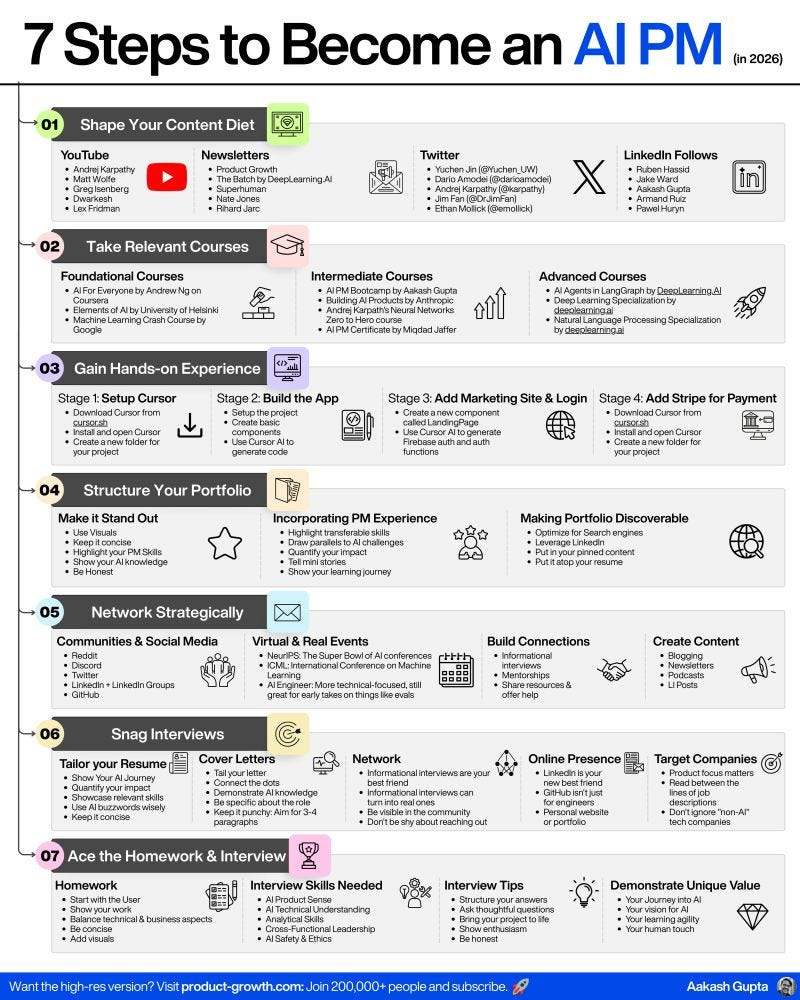
A step-by-step playbook to land $500K+ AI PM roles in 2026. AI PM roles pay 2–3x more due to scarce, high-bar talent. You can often find $350–700K+ total comp. Aakash Gupta shares 7 steps to land an AI PM role: daily learning, structured courses, ship actual AI products, create a standout portfolio, deep networking, targeted applications, and rigorous interview prep. Complement with Paweł Huryn‘s article on the 5 skills that separate $184K AI PMs from $737K AI PMs
The 26 most important ideas for 2026. Derek Thompson explains some of the most relevant shifts that will drive economics, politics, and technology in the near future. Not a “Product” article, but one that will influence how you think about new (or your) products
That’s a wrap for this week.
Have a great weekend, and a great start of 2026!