Week in Product #472 🚀
Designing with Cursor, Evals at Booking, Google Stitch gets smarter, Spotify's new features, 2026 IPOs, Apple's AI wearable, How Gusto found PMF, Claude Code guide & more

Hi friends 👋
Welcome to a new Week in Product!
🎰 The week in figures
$20B: OpenAI hit $20B in annualized revenue in 2025, up 233% from the prior year. Revenue grew from $2B in 2023 to $6B in 2024, and now $20B+. OpenAI expects to burn through $17B in 2026, with 85% of revenue going to GPU compute costs
$270M: Yelp announced acquisition of AI lead management platform Hatch for $270M. Hatch helps service businesses connect with customers via AI-powered communication across text, email, and voice. The platform had $25M ARR with 70% YoY growth
$207M: Pennylane, the Paris-based fintech startup funded by ex-booking.com colleagues, just raised €175M ($207M) to double down on AI for accounting and financial management, and push toward profitability
$150M: Inferact raised $150M at an $800M valuation to commercialize vLLM, the open-source inference engine. vLLM already powers AI at Amazon and major cloud providers. Companies report inference speeds 2-24x faster than standard implementations through innovations like PagedAttention and continuous batching
$150M: Preply, the language learning platform, raised a $150M Series D, now valuing the company at $1.2B. The app connects subscribers with real human teachers, who instruct them live via one-on-one sessions. The company works with over 100k human tutors, whom it now plans who compliment via AI integrations. I’ve been learning Czech via Preply for the last 2 years, and I love it!
$100M: LiveKit raised $100M at a $1B valuation to scale its real-time AI and media platform. LiveKit powers OpenAI’s ChatGPT voice mode, xAI, and Salesforce. The company anticipates 2026 will be the year voice AI is broadly deployed across thousands of use cases
90%: Runway’s research found over 90% of participants couldn’t reliably distinguish Gen-4.5 AI videos from real footage
40%: Anthropic’s margins are down from 50% to 40% due to the cost of running inference on Google and Amazon’s servers being 23% higher
3.5x: analysis from SensorTower shows that Amazon’s Rufus AI Assistant drove 3.5× higher conversion than non-Rufus sessions
📰 What’s going on
Anthropic CEO Dario Amodei said we’re 6-12 months from AI doing most coding work end-to-end. Speaking at Davos, Amodei revealed that Anthropic engineers already don’t write code anymore - they just edit what Claude produces. Claude Cowork was built in under two weeks, almost entirely by Claude itself
Anthropic published a new ‘constitution’ for Claude detailing how the model handles the balance between helping users and safety. Unlike its previous simple list of principles, the new constitution explains the reasoning behind each guideline. Anthropic says this helps Claude generalize better across novel situations rather than mechanically following rigid rules
Google Stitch launched MCP server support and Agent Skills at its first Developer Week. New Agent Skills include a design-md Skill that generates a document outlining your product’s design system, and a react-components Skill that converts designs into React components. Coding agents like Cursor and Claude Code can now connect directly to Stitch designs
Gemini is evolving into a proactive AI agent in Chrome thanks to Skills, with the ability to take actions like scheduling events
OpenAI will begin testing ads for free ChatGPT users within weeks. Sponsored products and services will appear at the bottom of conversations. The company pledged not to show ads to users under 18 or during chats about health or politics
Meanwhile Google claimed that the company plans to avoid ads in Gemini outputs. At least, for now
OpenAI and Anthropic could IPO as early as late 2026 or early 2027. As many as 8 VC-backed AI startups have begun prepping for IPOs this year, including Lambda (cloud provider), Cerebras (chipmaker), and Crusoe (datacenter). SpaceX is also expected to go public in the second half of 2026
xAI is testing internal AI systems known as “human emulators,” which are fast computer-using agents that directly see the computer screen, click, and type like human agents. They are designed to behave like white-collar employees and interact with real staff, with some already appearing on company org charts and leading to awkward situation, like asking real human colleagues to meet at desks that don’t exist
YouTube outlines 2026 roadmap. The plan doubles down on creators as the new “studios,” with every format from Shorts to multiview TV built around them. The company is tightening kid/teen controls and expanding monetization so creators can earn through ads, shopping, fan funding and brand deals. AI is the other big pillar: YouTube wants it to supercharge creation and discovery while filtering out “AI slop”
Meta has began to internally deploy its new reasoning models, codenamed “Avocado” (for code/logic) and “Mango” (for images)
Alibaba and Tencent are pivoting to "Agentic Commerce," where apps give way for agents who handle payments automatically or plan parties
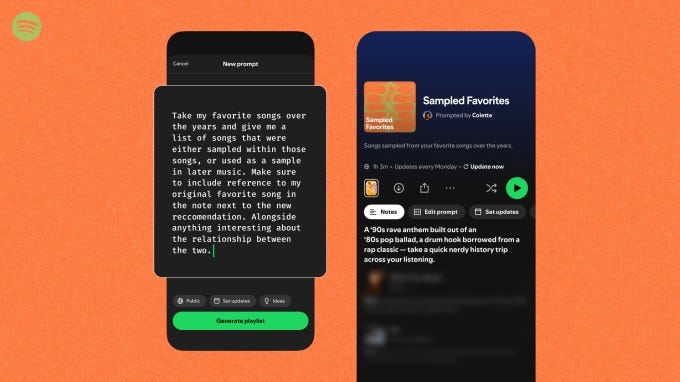
Spotify launched a new prompt-based tool that builds niche 30-song playlists
Spotify is testing out a new feature called Page Match that will allow users to scan a page of a physical book and start listening to an audiobook from that page
Apple reveals it is developing a dedicated screenless AI wearable to further integrate Siri. The AirTag-sized "AI Pin" will have multiple cameras and microphones
OpenAI confirmed its own screen-free device is on track for late 2026
Affirm to pilot a "buy now, pay later" option for monthly rent payments, allowing tenants to spread the cost of housing over several installments
PayPal introduced a free, DIY tax filing service within its app to simplify the return process for its millions of U.S. customers
ByteDance reached a deal with outside investors that will keep TikTok available for US users. Those investors include Oracle, U.S. investment firm Silver Lake, Emirati investment firm MGX, and Michael Dell’s investment firm, among others
📚 Good reads
The Infinitely Customizable Basic App, by Jaclyn Konzelmann. As AI makes it trivial to build hyper-personalized software, a product tension emerges: do users want apps ‘just for them’ or shared experiences with community and tutorials? Most users don’t want to be PMs; they want opinionated software that does the thinking for them
What cold-calling from a closet taught Gusto’s founder about PMF, by First Round Review. Gusto co-founder Tomer London shares how relentlessly cold-calling potential customers taught him to recognize what PMF really feels like. When exploring both SMB and enterprise, they discovered SMBs were much more enthusiastic; a pivotal insight that shaped the $9.6B company
The State of UX 2026, by NN Group. UX is stabilizing, but the rules have changed. UI alone won’t differentiate your product in 2026 as design systems standardize. Adaptability, strategy, and discernment will distinguish thriving UX professionals
Your Enterprise AI Strategy is Backwards, by Reid Hoffman. Most enterprises focus on moonshot AI transformations, but the fastest path to ROI is applying agentic tools to the unglamorous coordination layer: meetings, notes, action items, status updates... Language models love context, and the biggest language workload is coordination. Start there
AI agent evaluations. Booking.com breaks down how to judge AI agents using both black box outcome metrics like task completion and glass box internals like tool validity, correctness, and reliability. They show how to benchmark agents against simpler LLM baselines using performance, cost, and latency, and when the extra complexity is actually worth it. The piece also touches on advanced eval topics PMs should care about
[Video] How to build ChatGPT apps (the next App Store?). Live demo, by Aakash Gupta and Colin Matthews, who joins to break down MCP protocol, demonstrate live building, and discuss eval strategies for ChatGPT apps. The episode explores why this could be the biggest new PM distribution channel since the App Store
🧑💻 Worth learning
Designing with Cursor. This guide shows how non-coding designers are using AI agents (Cursor + Claude Code) to create fully deployed sites and apps. It proposes a simple workflow to prototype full-stack experiences
The shorthand guide to everything Claude Code
7 NotebookLM Use Cases to try
🔧 Cool products to try
Google’s Stitch turns prompts like "dark fitness app with neon accents" into working UI designs and HTML/CSS code you export to Figma or paste into your IDE, now with MCP server and Gemini CLI integrations for coding agents. Free to try. And they released a handy prompt guide
Noodle Seed: build a no-code AI app so it’s discoverable inside ChatGPT and other AI assistants - hit #1 on PH
That’s a wrap for this week.
Feel free to drop your comments / questions / feedback. Would love to hear what you’d like see more about in WiP, so I can make it better for you!
Have a great weekend.